First Hard Lesson in Behavior-Based Safety

It was the mid-90’s and Major Oil and Chemical companies were striving to improve their capital project efficiency. New business based project work processes were under development that were based on stage gated work phases that allowed for thoughtful and timely business and economic decisions. It was at this time as well that safety was getting attention as part of these work processes. Construction work safety performance was relatively poor in the early 90’s and it was apparent that safety needed to be a very essential element in these new policies and procedures for ethical and business reasons.

In the 1990’s I was working as a Project Manager for Amoco Corporation in their Worldwide Engineering and Construction office in Clear Lake, near Houston. A team was set up to develop the new business project work process that would be implemented across all business units. The name of this set of new project execution rules was called the Amoco Common Process or ACP. Although the title was not too exciting, the program was. The “Process” had a very detailed Front End Loading Process with three stages, each stage with prescribed deliverables and Value practices that ensured that the required project definition was completed at each stage for a thoughtful business decision to move forward. The Process included all aspects of Project Execution: engineering, procurement, construction, commissioning, and safety.

My project was a restart of a de-commissioned paraxylene facility at the Amoco Decatur Chemical plant. The scope was to rebuild and replace the equipment in both the hot and cold ends of the unit, there were a few active process areas in the unit that had to focused on for safe project execution. The PX-1 Restart project was to be one of three ACP “pilot” projects. All aspects the ACP were followed rigorously and that included a new focus on behavior based safety. The project would be actively pursuing “leading” safety indicator behaviors and not just focus on the “lagging” indicators that was used in the past. What are leading and lagging indicators for safety?

Lagging:

➤ Recordable Incidence Rate
➤ Lost Time Rate
➤ Near Miss reporting
➤ Safety Investigation

Leading:

➤ Pre-Job Safety Planning (JSA) for each task
➤ Multi-functional Safety Walkthrough with all team members and contractors
➤ Safety Observations, both good and bad
➤ Overall project safety execution plan before construction mobilization
➤ Scoring of the quality of JSAs and Safety Observations
➤ Trending of Safety Observations to identify trends before an accident happens and starting a campaign to address any issues.

The Decatur PX-1 Restart project was to focus on the leading indicator practices to ensure exceptional safety performance. Our EPC contractor was totally onboard, and construction started at the end of 1995.

Construction on this project was challenging. Some of the lines and equipment in the “hot end” were still in operation, the “cold end” was totally shutdown. A lot of the old equipment like centrifuges, pumps, and exchangers had to be replaced in kind. Cryogenic insulation on vessels and piping had to be replaced. The control room was demoed, and a new control room was built offsite. And there was a 30-day unit shutdown in the “hot end” to perform our new equipment and piping installations. Job Safety Analyses were performed for every task every day and they were routinely audited. Joint safety walkthroughs with construction craft and management were routinely held. And safety observations were tracked and analyzed for potential safety trends. In short, this job was close to impeccable when it came down to safety performance and employee engagement. By Project completion we worked over 1.5 million workhours without an OSHA recordable injury. This was a quite a feat in 1997. It was time for a project wide safety celebration to mark this remarkable achievement!

A graph showing a crash

AI-generated content may be incorrect.

It was decided to hold the 1.5M safety celebration outdoors inside the plant in a parking lot. A catering company was brought in to grill BBQ on-site. Hundreds of project team members were in attendance from Amoco and all the other contractors. I was running late to the luncheon due to a call that was running over at the construction trailer. One of my construction managers came into my office in a rush and told me to come quick someone just blew themselves up at the celebration! I ran over to the celebration and found out the cook tried to light the grill with the lid down and caused a small gas explosion. This explosion burned his hands and forearms very badly. First aid personnel attended to him, and he was taken away by ambulance. Needless to say, this was a very bad look for a project that was ready to celebrate a perfect safety record. People were shocked and the luncheon was called off. Now I had to make the call to my management that I had a guy blow him self up at our safety celebration. I was sure this was my last day at Amoco.

Luckily, my management was more understanding than I thought. They just wanted to make sure that we support the injured chef as much as we could. But this event brought a great awakening:

Everyone involved had an ah-ha moment: Safety is not just for the job site!

We did everything correct when we were in the field but let our guard down when we were offsite and planning on enjoying some time celebrating. If we would have continued to follow our policies and procedures when it came to the safety luncheon this injury could have been minimized or never even happen.

➤ A Job Safety Analysis would have been performed on the grilling procedure. Most likely some form of PPE would have been required like grilling gloves that protect the forearm. We probably would have caught and mitigated the poor “light the grill with the lid down” decision.

➤ With proper safety execution planning we might have even decided that grilling onsite was a bad idea and should be done offsite in a safer environment.

This incident reminded all of us that safety is a 24/7 activity, at work or at home. After the incident it seemed so obvious, but it wasn’t even a thought before. Times have changed for the better!

The chef was released from the hospital and fully recovered. We re-scheduled the safety celebration, and everyone had a good time. The PX-1 unit started up and the project was deemed a success.

A few months later, at another project’s safety celebration, a worker cut himself with a pocket knife that was given out as a safety gift. But that is a lesson for another time…….

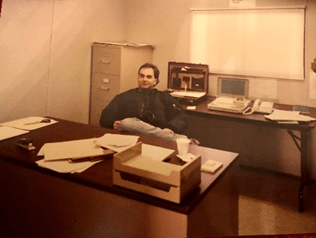
First Offer Letter

I recently found my first offer letter while rummaging through some storage boxes. 

I received a few offers of employment when I graduated college, but Amoco excited me the most. With a whopping $35,000 a year salary and 2 weeks of vacation (after my first year of service), I accepted a January 1990 start date at their downtown Chicago office.  

My 9 years at Amoco (and BP) provided an awesome learning experience for me; their engineering and refining training was second to none. 

I carry these skills and experiences with me today in all my project execution endeavors.  

North Dakota KISS Sighting

October 2, 1990, Bismarck, ND

Six months after graduating from the University of Illinois Chicago in mechanical engineering, I found myself running critical environmental projects at Amoco’s Mandan ND refinery. I joined Amoco Corporation out of college in January 1990 as a Project Engineer at their downtown Chicago office.

After 6 months of tedious hydraulic pump calculations, an opportunity for a site assignment became available after it became evident to Amoco that all of their refineries and chemical plants were going to have to comply with the upcoming TCLP (Toxicity Characteristic Leaching Procedure) regulation that needed to be implemented by March 1991. This regulation severely restricted the amount of benzene that can be disposed of outside the refinery property limit into waterways.   Scrambling to find enough engineers to meet this deadline, they picked a very young engineer like me to pack up and head to Mandan to achieve the impossible in 8 months.

My boss met me at the refinery, which sits right across the Missouri River from Bismarck. He introduced me to my project team (all contractors from Stone and Webster Houston), my environmental contractor, Environcon, and my local construction team, NCI, all housed in a trailer complex. He said these are your guys; get it done no matter the cost. Our project: A major update to the oil and water separator (API separator) had to be accomplished, along with constructing 2 huge HDPE-lined bio-oxidation ponds with floating aeration. A large task indeed.

After a lot of design work on cocktail napkins, we finally had a plan to get this work done. Lots of mistakes were made and corrected, and I witnessed my first OSHA recordable injury due to rushing to meet schedule (a worker lost consciousness after being hit on the head with a HDPE liner spool). But I’m not here to bore you with all the technical details and the bathroom trips to the outhouses in -40F temperatures or how, in March of 1991, the Refinery Manager allegedly drank the water from the wastewater outlet, the project was deemed a success.  

What I do want to talk about is the awesome KISS concert I saw on October 2, 1990. One of my Amoco colleagues, Gary, was coming to the Mandan site for a safety inspection. He was on the Northwest flight with me from Minneapolis to Bismarck the morning of October 2nd. Gary was in first class, and I was in coach.

I saw Kip Winger at the airport and briefly talked with him before the flight. Unbeknownst to me, all of the KISS and Winger bands were in first class with Gary during the flight. Gene Simmons invited Gary to the backstage event at the concert that night and front stage pit passes. After landing, he told me the news and that was going to be awesome.

I left work early and returned to the Expressway Inn, my home away from home, in Bismarck. Gary and I met up and went to pregame at local bars, then headed to the Civic Center for the concert. A band as popular as KISS was rare for a small town like Bismarck, so the Civic Center was packed and excited.

As expected, the backstage passes awaited us, and we entered the waiting room. There were a lot of people of all ages back there. After a short period, Gene Simmons, Tommy Thayer and Eric Carr came into the room and started to mingle with the crowd. Paul Stanley was a no-show at the backstage event.

A lot of autograph signings by the performers took place; Eric Carr handed out earplugs to the children in the room, stating that the show would be very loud. Gene Simmons was also engaging, but his signature technique for women was unique. He would only sign the paper if it were placed on the woman’s chest (with clothes on, of course), which was quite awkward even in the 1990s. I left with signatures on cocktail napkins from all 3 members, quite memorable for a young person like me.

After the meet and greet, we moved to the pit area in front of the stage for the show. Winger was already opening the show, and I saw about half of that performance. KISS then came out with a giant Sphinx in the center of the stage with laser beam eyes. When they say they are the loudest band in the world, they are not kidding. Explosions, flames, smoke, and “blood” spitting all took place with incredible precision. And man, it was ear-piercingly loud in the pit.

The setlist was incredible and very long for concerts at that time:

KISS Setlist, October 2, 1990, Bismarck Civic Center

  • I Stole Your Love
  • Deuce
  • Heaven’s on Fire
  • Crazy Crazy Nights
  • Black Diamond
  • Shout It Out Loud
  • Strutter
  • Calling Dr. Love
  • I Was Made for Lovin’ You
  • Rise to It
  • Fits Like a Glove
  • Hide Your Heart
  • Lick It Up
  • God of Thunder
  • Forever
  • Cold Gin
  • Tears Are Falling
  • I Love It Loud
  • Love Gun
  • Detroit Rock City

Encore Songs

  • I Want You
  • Rock and Roll All Nite

More information from this concert can be found on setlist.com at KISS Concert Setlist at Bismarck Civic Center, Bismarck on October 2, 1990 | setlist.fm

It was a great night for a KISS fan like me. Heading to work the next day at 7 am was difficult, but those environmental projects needed to get done.

Did you know mule deer like steamy chemical-filled bio-oxidation ponds? A few went swimming with their sharp HDPE-piercing hoofs and antlers? Well, that story is to come……….

Why Safety is so much more than a Minute

Safety is paramount in today’s workplace. And for good reason. Unsafe acts and conditions lead to injury, lost time, lost wages, or even death.  It can also do severe damage to a corporation’s reputation.  It is something so important that companies often start every meeting and event by having a Safety Minute or Safety Moment.

But why would something so important be only a minute?

Transitioning from a Safety Minute to a Safety Conversation or Discussion is an excellent idea. While a Safety Minute can serve as a brief reminder of the importance of safety, it often lacks depth and engagement. By expanding it into a conversation or discussion, you create a platform for meaningful interaction and learning among employees and management.

A Safety Conversation allows for the exchange of experiences, insights, and best practices related to safety. It encourages active participation and empowers employees to contribute their knowledge and observations. By discussing safety not only in the workplace but also in personal life, it reinforces the idea that safety is a fundamental aspect of everyday living.

A Safety Conversation fosters a culture of continuous improvement and accountability. It encourages individuals to not only identify unsafe actions and conditions but also to propose solutions and preventive measures. This collaborative approach promotes a sense of ownership over safety within the organization, leading to better adherence to safety protocols and reduced risk of accidents.

Transitioning from a Safety Minute to a Safety Conversation or Discussion reflects a commitment to prioritizing safety as an ongoing dialogue and practice. It emphasizes the importance of collective awareness, vigilance, and action in creating a safer workplace and community.. and it so much more than a minute.

Safety Learnings from the Sinking of the Titanic

In 1912, before its maiden voyage, the RMS Titanic’s design fascinated the world as the largest and most luxurious ship ever built. While it set sail with great fanfare, it was doomed from the start and serves a haunting reminder of the catastrophic consequences that can result from a combination of engineering design flaws, outdated standards, lack of training, inadequate tools, poor communication, and empty safety mottos.

Quality Control/Engineering Design Problems

Outdated Standards and Specifications

While the ship met the lifeboat standards at the time, the regulations and safety codes were woefully out of date for increasingly larger ships being built. The 20 lifeboats could only save, at best, 1,000 of the 2,200 people on the ship.

Lack of Training

The required lifeboat drills the day before the accident were canceled by the captain for unknown reasons. The passengers, therefore, were not trained to find and use the lifeboats, leaving lifeboats at half-full capacity. Additionally, portholes were left open and contributed to a faster sinking.

Lack of Adequate Tools and Equipment

The ship lacked enough binoculars and searchlights for the crew, which contributed to a reduced response time in the event of danger, leaving only 37 seconds to react and avoid the iceberg.

Lack of Communication

The ship Californian was near the Titanic and could have saved many people, however, the Titanic’s sole radio operator turned off the radio and went to bed. This led the U.S. Government to enact 24-hour emergency radio communication.

Empty Safety Mottos/Statements

“God Himself Could Not Sink This Ship,” “Practically Unsinkable,” and “Safety Above All Else”

are empty statements and mottos without substance. Not having enough lifeboats, canceling drills, and inadequate safety equipment clearly demonstrates that safety was not their primary motivation.

Conclusion

Unfortunately, the Titanic was not the last to experience these safety failures. Many of these causes still plague projects today. Take the time for Safety Reviews, Process Safety Reviews, Checklists, Passgates, Lessons Learned, and Peer Reviews to minimize these safety risks to your project. By learning from the mistakes of the past, we can strive to minimize safety risks and ensure the well-being of those involved in future endeavors.

Monkey Business

Most of you might not know that I lived and worked in Morocco for over 5 years. I worked for a joint venture between Jacobs Engineering and the government-run chemical company OCP.   I have heard great things about Gibraltar and wanted to visit. 

In the summer of 2013, my colleague Roy and I embarked on an impromptu adventure to Gibraltar, a ride of about 4.5 hours. Little did we know that our escapade would involve more than just scenic views and vibrant pubs. Buckle up for a tale of unexpected monkey business that will leave us with a great story to tell.

Since it was our first time crossing the strait of Gibraltar, we were unaware that there were 2 ports on the Mediterranean, Tangier City and Tangier Med.     Tangier City is for passengers and cars, ferries there are smaller and faster.   Tangier med, on the other hand, is for larger ferries that carry passengers and cars along with trucks and cargo.   These ferries are much larger and slower.  

Since we went to Tangier Med port, the ferry was 3 hours late leaving due to the loading of cargo.    We finally arrived in Spain and then Gibraltar by taxi around midnight.

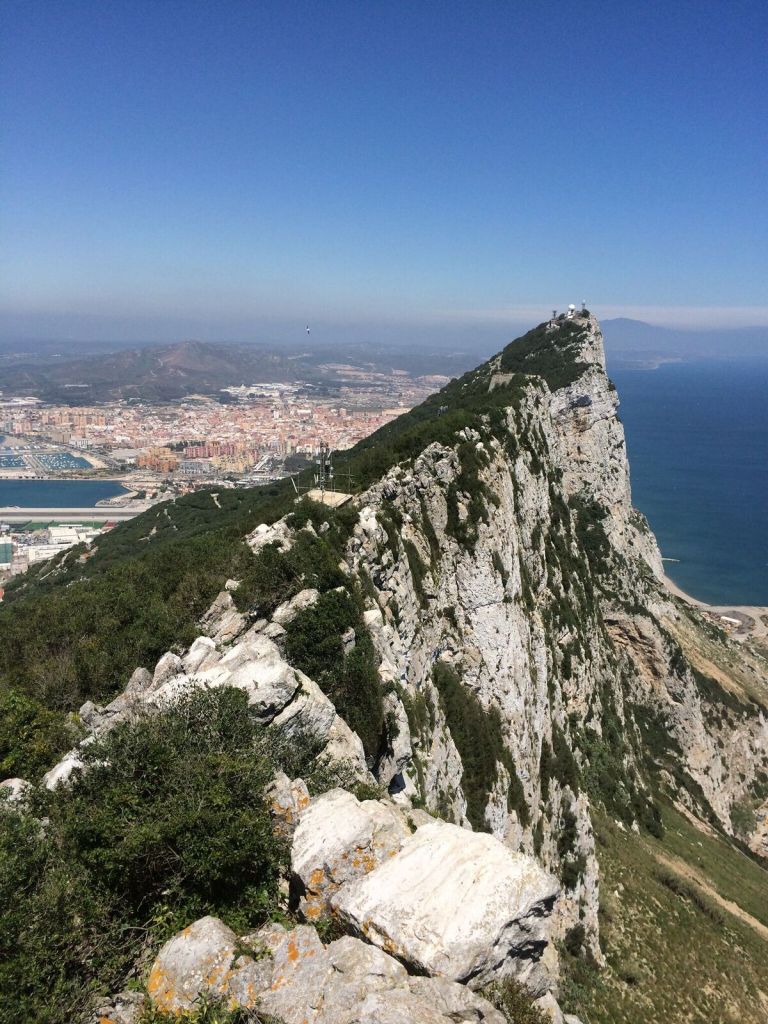
Gibraltar is a British overseas area at the tip of the Spanish peninsula, a mere three-square miles housing 32,000 people and an astonishing 60 pubs. Eager to explore, we dropped our bags at the hotel and dove headfirst into the nightlife of this lively town.

A chance encounter with a group of spirited Brits led us on a pub-hopping escapade, the night unfolding with laughter, camaraderie, and spirits flowing like a mighty river. We drank with them at many pubs and got back to the hotel room around 4 am.  

I found the balcony door curious since it was not a sliding door but a normal latch glass door.   I walked out on the balcony to check the view and then went back in and went to sleep.

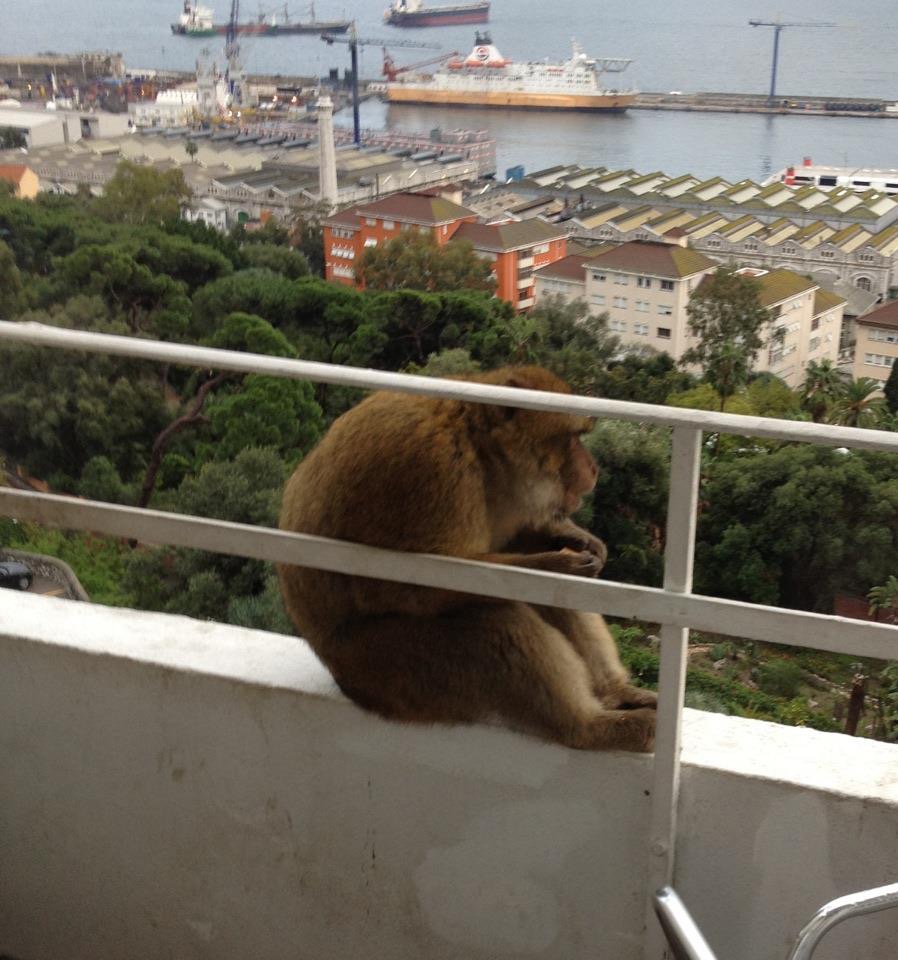
A cacophony of sounds and an unpleasant odor roused me from my slumber. To my disbelief, a Gibraltar ape—a sizable one at that—was feasting on the cookies the hotel had left for me. Thinking on my feet, I improvised, using the bedspread to coax the cheeky intruder out of the room. The photo I managed to capture immortalized the moment—an ape gleefully finishing off my late-night snack.  He used his monkey hands to open the balcony door since I left it unlocked.  In a display of acrobatics, the ape leaped to the balcony above, leaving me dumbfounded.  After all I was on the 8th floor. 

I personally think that the hotel should warn guests of the surprise monkey guests coming into unlocked rooms and to make sure the balcony door is locked.  The hotel, unfazed by my predicament, informed me that the apes often descend from the mountains at night, a fact they assumed most guests were aware of. Their parting words about the apes being potentially dangerous and buttock-tearing enthusiasts came a day too late.

Now a little about Gibraltar apes: 

The Barbary macaque population in Gibraltar is the only wild monkey population on the European continent.

As they are a tailless species, they are also known locally as Barbary apes or rock apes, despite being classified as monkeys.  There are about 300 of them in Gibraltar and the population is growing every year..  Most of them have names and the locals write about them.   They are overseen by the British military. 

There is a cable car that goes from the center of town to the top of the mountain.   It’s a great view but most people go to see the apes.   There are photo ops up there but if you bring a bag or food, they will take it.  They like purses and pringle cans. 

So next time you are at a Gibraltar hotel, make sure the balcony door is locked or you too might wake up to some monkey business.  

Lead By Example

“What you do speaks so loudly that I cannot hear what you say.”

A proclamation so strong that JFK chose to use it in an emotional speech in 1960.   Do you know leaders who epitomize this statement? It’s easy to repeat safety mottos, corporate values, vision statements, performance absolutes, and the like.   But the “do as I say, not as I do” mentality only goes so far. After all, it’s not what we say, it’s what we do that matters.

Many of us have the best of intentions when we state lofty expectations. But our actions are on display every day and if we do not lead by example with our peers, we might as well say nothing at all.   Credibility and respect are earned by backing up our words with direct and visible action. It’s best to set the standard by way of example—otherwise, we might never be heard. Don’t let your best intentions be lost in the din of inaction. Remember, it’s what we do that really counts.